
Two charged particles, each with a charge of $+q$, are located along the $x$-axis at $x = 2$ and $x = 4$, as shown below. Which of the following shows the graph of the magnitude of the electric field along the $x$-axis from the origin to $x = 6$?
- A
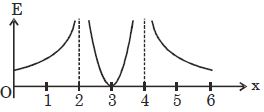
- B
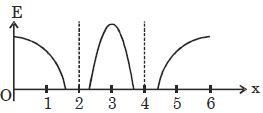
- C
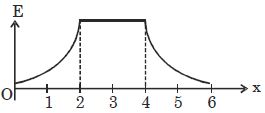
- D
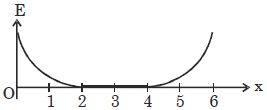
Explore More
Similar Questions
$A$ circular wire loop of radius $1 \, cm$ carries a total charge $1 \times 10^{-6} \, C$ distributed uniformly over its length. If $0.01 \%$ of its length (circumference) is cut off, then the electric field at the centre of the loop due to the remaining wire is
$(\text{Take} \, \frac{1}{4 \pi \varepsilon_0}=9 \times 10^9 \, \text{SI unit})$
$(\text{Take} \, \frac{1}{4 \pi \varepsilon_0}=9 \times 10^9 \, \text{SI unit})$
Two non-conducting spheres of radii $R_1$ and $R_2$ and carrying uniform volume charge densities $+\rho$ and $-\rho$,respectively,are placed such that they partially overlap,as shown in the figure. At all points in the overlapping region:
$(A)$ the electrostatic field is zero
$(B)$ the electrostatic potential is constant
$(C)$ the electrostatic field is constant in magnitude
$(D)$ the electrostatic field has same direction
$(A)$ the electrostatic field is zero
$(B)$ the electrostatic potential is constant
$(C)$ the electrostatic field is constant in magnitude
$(D)$ the electrostatic field has same direction
DifficultIIT 2013
View Solution$A$ charge produces an electric field of $1\, N/C$ at a point distant $0.1\, m$ from it. The magnitude of the charge is:
Medium
View SolutionThe electric field lines on the left have twice the separation of those on the right as shown in the figure. If the magnitude of the electric field at $A$ is $40 \ Vm^{-1}$,what is the force on a $20 \ \mu C$ charge kept at $B$?
Two conducting spheres of radii $r_1$ and $r_2$ are charged to the same surface charge density. The ratio of electric fields near their surfaces is
Vedclass Products
For Students
Vedclass Test Series
Mock tests in real JEE/NEET style with performance analysis. 5-day free trial.
Start Free TrialFor Teachers
Exam Paper Generator
Generate Set A/B/C/D exam papers from 7.5L+ questions in 2 minutes. 3 chapters free.
Try FreeFor Institutes
Online Exam Module
Live online exams with unlimited students, 360° analytics & white-label branding.
See Demo